Research
How does a species become invasive? This question guides most work in our lab.
Invasive species like the starling are a kind of companion species, and they threaten global biodiversity. We study invasive species from both social and biological perspectives.
Our lab uses genomic, ecological, and historical evidence to reconstruct invasion history, with a focus on the European Starling. We ask questions like:
why are invasive starlings declining in North America?
how did starlings evolve and possibly adapt to novel environments?
how do scientists collect and interpret data on invasiveness?
how do the dynamics of range expansion differ between native and invasive species?
Scroll down to see ongoing projects and a selected list of the lab’s publications.

Accommodating a generalist diet
Starlings are famously opportunistic in their diet: they will allegedly eat anything. Their generalist habit is part of what makes them successful invaders. However, even starlings prefer to feed on soil invertebrates during the breeding season. And in the non-breeding season, they descend on dumps, cattle feedlots, and any readily-available food sources.
If starlings will eat anything, how and why do they seek out particular food sources? In this project, we are surveying starling dietary diversity across seasons, and investigating mechanisms that facilitate such dietary shifts.
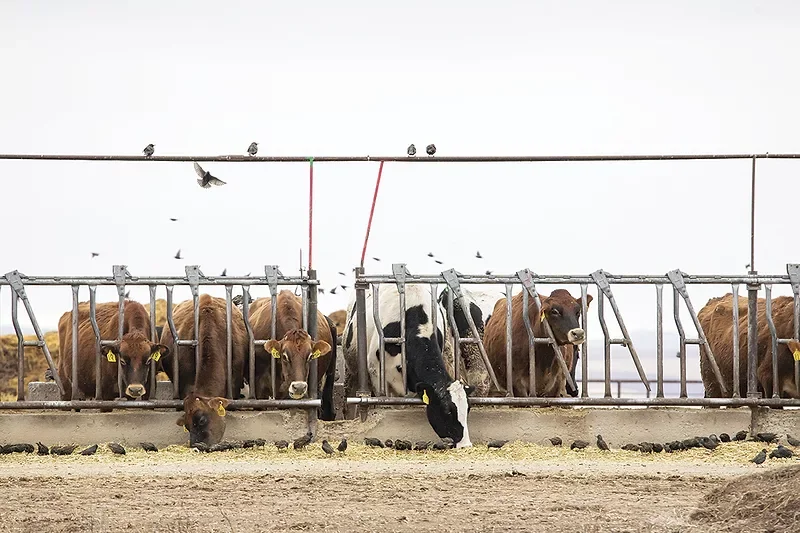
Starlings at a cattle feedlot. Photo by Mike Dixon (2022, AgProud).
Identifying drivers of population decline
Like most birds in North America, starlings are declining. In fact, this decline seems to be accelerating. As a rule, invasive populations are not expected to decline. Whether and how starlings’ decline differs from that of native birds remains an open question. We are using citizen science data to identify potential drivers of local population declines.
Even as starling populations decline, their range in North America continues to expand. Ongoing work in the lab is using genomic and isotopic data to explore population connectivity across their invasive range.
Defining an invasive species
Starlings fit some but not all our assumptions of an invasive species. Natalie’s book project, Citizen Starling, reflects on how ornithologists and invasion biologists shaped the story of starlings’ invasion in the U.S. When starlings visit agricultural operations like the one on the left, they sometimes do so in mixed flocks with red-winged blackbirds and other native pests. If pests travel in such mixed flocks, what differentiates starlings from native pests in an ecological sense?
As a lab, we are interested in the natural history of starlings in the U.S., including in testing our assumptions about how starlings breed, how they move, and how this invader evolved within a family of relatively range-restricted species.
Publications
Hofmeister, NR, KC Stuart, WC Warren, SJ Werner, M Bateson, GF Ball, KL Buchanan, DW Burt, APA Cardilini, P Cassey, T De Meyer, J.George, SL Meddle, HM Rowland, CDH Sherman, WB Sherwin, W Vanden Berghe, LA Rollins, and DF Clayton. 2025. Concurrent invasions by European starlings suggest selection on shared genomic regions even after genetic bottlenecks. Molecular Ecology 34(14):e17195 https://doi.org/10.1111/mec.17195
cover article
Stuart, KC, RJ Edwards, Y Cheng, WC Warren, DW Burt, WB Sherwin, NR Hofmeister, SJ Werner, GF Ball, M Bateson, MC Brandley, KL Buchanan, P Cassey, DF Clayton, T De Meyer, SL Meddle, LA Rollins. 2021. Transcript- and annotation-guided genome assembly of the European starling. Molecular Ecology Resources 22(8):3141-3160.https://doi.org/10.1111/1755-0998.13679
Hofmeister, NR, SJ Werner, and IJ Lovette. Environmental correlates of genetic variation in the panmictic European starling in North America. 2021. Molecular Ecology 30(5):1251-63, doi: 10.1111/mec.15806.
Press: All About BirdsForbesCornell Chronicle
Toews, DPL*, NR Hofmeister*, and SA Taylor. 2017. The evolution and genetics of carotenoid processing in animals. Trends in Genetics 33(3):171-82, doi: 10.1016/j.tig.2017.01.002. (*shared first authorship)
Hofmeister, NR, and DR Rubenstein. 2016. Environmental variability and the evolution of the glucocorticoid receptor (Nr3c1) in African starlings. Ecology Letters 19(10):1219-27. doi: 10.1111/ele.12656.
Hofmeister, NR, M Welk, and S Freedberg. 2013. Elevated levels of ∂15N in Riverine Painted Turtles (Chrysemys picta): Trophic enrichment or anthropogenic input? Canadian Journal of Zoology 91(12): 899-905. doi: 10.1139/cjz-2013-0121.